
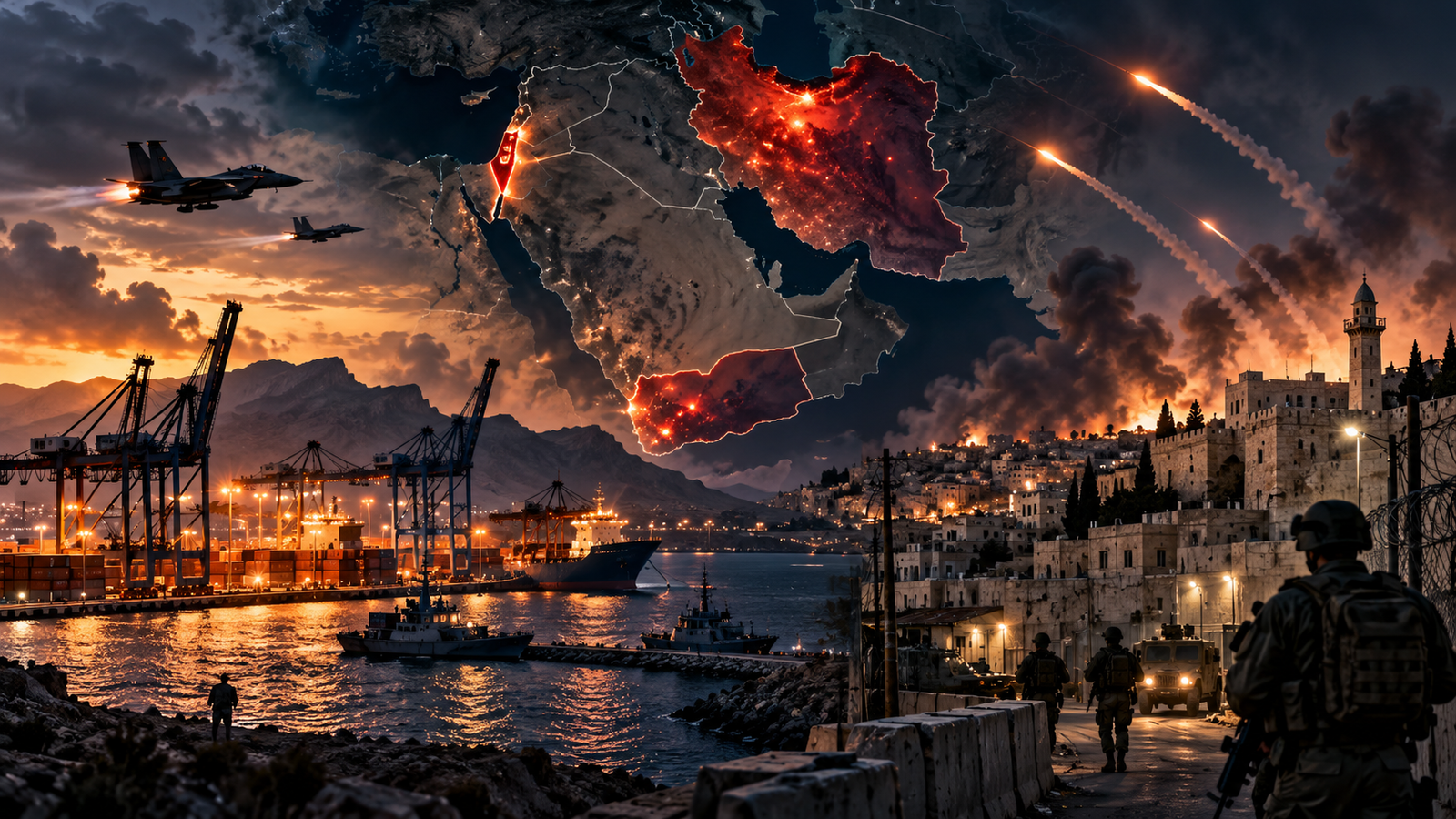
The Israel-Iran conflict is showing fresh signs of regional expansion, with renewed Houthi attacks in Yemen, a major Israeli military operation in the occupied West Bank and growing concern in Washington over threats to American personnel across the Middle East.
On Saturday, Yemen’s Houthi movement said it had attacked the Al-Nasr military camp and a naval base in the southern city of Aden, the temporary seat of Yemen’s internationally recognised government. Explosions were reported in the city, while Houthi military spokesman Yahya Saree said the targets were facilities associated with Saudi-backed forces. There was no immediate independently verified assessment of casualties or the extent of damage.
The attack forms part of a much broader escalation in Yemen. Aden has been repeatedly targeted in recent weeks, including strikes on the presidential palace complex and the city’s international airport. Earlier attacks killed government security personnel and threatened civilian aviation, while fighting has intensified between Houthi forces and the Saudi-backed Yemeni government.
Saudi Arabia, meanwhile, said its coalition intercepted two Houthi ballistic missiles on Saturday that were heading towards Taif and the strategically important Red Sea city of Yanbu. Saudi civil-defence authorities briefly issued alerts in Taif, Yanbu, Mecca and Jeddah before declaring that the immediate danger had passed. The renewed fighting has effectively shattered the relative calm created by the 2022 UN-brokered truce and opened another active front in the wider regional confrontation.
Hebron operation follows killing of Israeli soldiers
At the same time, Israeli forces have begun a large military operation around Hebron in the occupied West Bank following an attack on Friday in which two Palestinian gunmen opened fire near a military checkpoint, killing two Israeli soldiers and lightly wounding three others.
The Israeli military said both attackers were killed and announced that troops would conduct searches for weapons and suspected militants in neighbourhoods from which the gunmen had operated. The operation is expected to continue for several days.
Residents of the affected areas have been instructed to leave through designated exit points after security screening. Israeli forces have also begun demolishing what the military describes as threatening infrastructure.
The scale of the displacement has become one of the most disputed aspects of the operation.
Reuters reported on Saturday that approximately 1,200 Palestinians had already been forced to leave their homes, citing a Palestinian official. Later reports placed the number around 1,500, while local officials warned that substantially more residents could face evacuation if the operation expands.
Hebron Mayor Yousef al-Jabari said additional homes were at risk and accused Israel of imposing collective punishment on the wider civilian population. The Palestinian Authority has made a similar accusation.
Israeli authorities, however, describe the operation as a security response directed at the area from which the attackers operated and say its purpose is to locate militants, weapons and infrastructure considered a threat.
The Palestinian Prisoners’ Club said about 70 Palestinians had been arrested during operations on Friday and Saturday. Reuters reported accounts from residents who said people with no connection to the shooting had also been forced from their homes.
Political tension adds another dimension
The Hebron operation is also unfolding only days before Israel’s parliamentary election.
Prime Minister Benjamin Netanyahu and senior ministers have adopted a hard line following the attack, while Palestinian officials have accused the government of using the security crisis for political advantage.
That allegation remains contested, but the timing means that military developments in the West Bank are now closely intertwined with Israel’s domestic political campaign.
The immediate security situation across the West Bank has also tightened. Closures and restrictions have affected movement between Palestinian towns and cities, with residents reporting difficulty reaching workplaces and medical facilities.
Washington raises security posture
The latest developments come as the United States is also reassessing security conditions across the region.
A U.S. intelligence memorandum seen by Reuters and obtained separately by the Associated Press warned that Iran had significantly increased efforts to target American personnel and that some alleged plots against U.S. citizens had reached advanced stages.
Washington has consequently reduced staffing at embassies in Jordan, Lebanon, Qatar and the United Arab Emirates. Non-essential U.S. government personnel and family members in Saudi Arabia had already been ordered to leave, while travel advisories for several Middle Eastern countries have been tightened.
U.S. officials say both Iranian threats and increased Houthi attacks have contributed to the security measures.
President Donald Trump has also left open the possibility of another U.S. military operation against Iran. Speaking on Friday, he suggested Washington could carry out another round of military action if negotiations with Tehran fail.
At the same time, diplomatic efforts to prevent another major escalation are continuing. Turkey has publicly warned that renewed attacks on Iran could broaden the conflict further and has urged a return to diplomacy.
Israel-Iran Conflict Increasingly Difficult to Contain
Taken together, the developments in Yemen, the West Bank, the Gulf and around U.S. diplomatic missions illustrate how difficult the regional confrontation has become to contain within a single battlefield.
The Houthi front is increasingly important because of Yemen’s location beside the Red Sea and Bab el-Mandeb, one of the world’s most important maritime routes. At the same time, instability around the Strait of Hormuz continues to threaten global energy flows.
Any further escalation involving Saudi Arabia, Iran, Israel or the United States could therefore have consequences extending far beyond the region, particularly for oil prices, commercial shipping and international markets.
The West Bank represents a different but equally sensitive front. A prolonged Israeli operation in Hebron, particularly if accompanied by large-scale demolitions or further displacement, could increase Palestinian unrest and deepen international criticism of Israeli policy.
The possibility of simultaneous escalation on several fronts is now the central risk.
A major new U.S. or Israeli strike on Iran could trigger Iranian retaliation against military or economic targets across the Gulf. Houthi attacks could intensify against Saudi territory and shipping routes. At the same time, further violence in the West Bank could place additional political and diplomatic pressure on Israel.
What to Watch Next in the Israel-Iran Conflict
Taken together, the latest developments show how the Israel-Iran conflict is increasingly drawing Yemen, the West Bank, the Gulf and U.S. security interests into a wider regional confrontation. Several developments over the coming days will indicate whether the current escalation remains contained or moves into a more dangerous phase.
First will be the extent of damage from the latest Houthi attack on Aden and whether Saudi-backed forces respond militarily.
Second will be the duration and scale of Israel’s Hebron operation, particularly whether additional Palestinian neighbourhoods are evacuated or demolished.
Third will be Washington’s military posture toward Iran. Any visible movement of additional U.S. aircraft, naval forces or air-defence assets would be closely watched for signs that another round of strikes is being prepared.
Finally, Iran’s own response will be crucial. Tehran has repeatedly warned that renewed attacks on its territory would produce a stronger response, while U.S. officials are simultaneously warning of increased Iranian efforts to target American interests.
The central question now is whether the Israel-Iran conflict can remain contained or whether continued escalation will pull additional regional actors into a broader confrontation.
That makes the risk of miscalculation considerably greater — and makes the coming days particularly important for determining whether the conflict begins to stabilise or moves into another, potentially more dangerous, phase.