

1. Overall Assessment
The international environment is entering an unusually uncertain period in which geopolitical tensions, political instability and economic pressures are beginning to overlap. Gold is trading close to the US$4,000 per ounce area, while silver is around US$53-54 per ounce. Both metals have already appreciated considerably, yet the broader conditions suggest that the upward cycle may not necessarily be over.
The path ahead is unlikely to be smooth. Precious metals can correct sharply even within a broader bullish trend. The next three months should therefore be judged not simply by whether gold and silver rise, but by the interaction of war, energy prices, interest rates, political uncertainty, the U.S. dollar and investor confidence.
2. Geopolitical Environment
The situation surrounding Iran remains one of the most important variables. Any widening of the conflict involving Iran, Israel or the United States would increase demand for traditional safe-haven assets. The Persian Gulf and the Strait of Hormuz are particularly important because any interruption in shipping or oil exports could cause another sharp rise in energy prices.
That development would normally favour gold. The complication is that a major increase in oil prices would also add to inflationary pressure in the United States and Europe. This could keep central banks, particularly the Federal Reserve, restrictive for longer. Higher bond yields and a stronger dollar tend to work against gold. The same geopolitical shock can therefore be bullish through safe-haven demand and bearish through inflation and interest rates at the same time.
Ukraine continues to add another layer of uncertainty. Markets have become accustomed to the war, but a significant escalation involving NATO countries, Russian energy infrastructure or wider European security arrangements could quickly restore a substantial geopolitical premium to gold.
3. Europe and the Risk of Political Stress
Political and social unrest in France is relevant because France is one of the largest economies in the European Union and a central member of the eurozone. The greater concern would arise if political instability begins to translate into financial instability through higher government borrowing costs, widening sovereign spreads or renewed doubts over fiscal sustainability.
If unrest remains largely domestic, its effect on bullion may be limited. If it becomes part of a wider European sovereign-risk or confidence problem, the implications for gold would be more substantial. In that case, investors would be responding not merely to street unrest but to questions over the stability of European public finances and the euro itself.
4. United States: Midterms, Gridlock and Fiscal Risk
The U.S. midterm elections on 3 November 2026 are a major near-term event. The market significance lies less in the identity of the winning party and more in the possibility of divided government and renewed confrontation over taxation, spending, government funding and the debt ceiling.
Financial markets can normally tolerate political disagreement in Washington. The risk increases when political confrontation starts to affect government borrowing, budget approval or confidence in fiscal management. A prolonged period of gridlock, especially alongside large deficits and rising federal debt, would be supportive of gold over time.
5. The Federal Reserve: Main Counterweight to the Bull Case
The Federal Reserve remains the strongest immediate counterweight to further gains. If inflation remains elevated, particularly because of energy prices, monetary policy may stay restrictive for longer than markets expect. High Treasury yields increase the opportunity cost of holding gold and can also support the U.S. dollar.
For that reason, a temporary correction toward roughly US$3,850-3,900 in gold and US$49-51 in silver would not by itself invalidate the three-month bullish assessment. In a market that has already risen sharply, corrections of this scale would remain within a normal consolidation pattern.
6. Silver: Higher Upside, Higher Risk
Silver differs from gold because it is both a monetary metal and a major industrial commodity. This dual role gives it potentially greater upside during a strong precious-metals cycle, but it also makes the metal more volatile during periods of economic or liquidity stress.
At present levels, the gold-to-silver ratio remains in the mid-70s. If gold rises toward US$4,400-4,500 and the ratio stays unchanged, silver could move toward about US$60. If the ratio compresses toward 65, silver moves closer to the high-US$60s; a move toward 60 would put silver in the low-to-mid US$70s. This is the main reason silver presently offers greater percentage upside than gold.
7. Thirteen-Week Projection
The table below sets out a base-case weekly trading range. These are not predicted Friday closing prices; they are working ranges intended to show the expected path and the events most likely to move the market.

8. Projection Chart
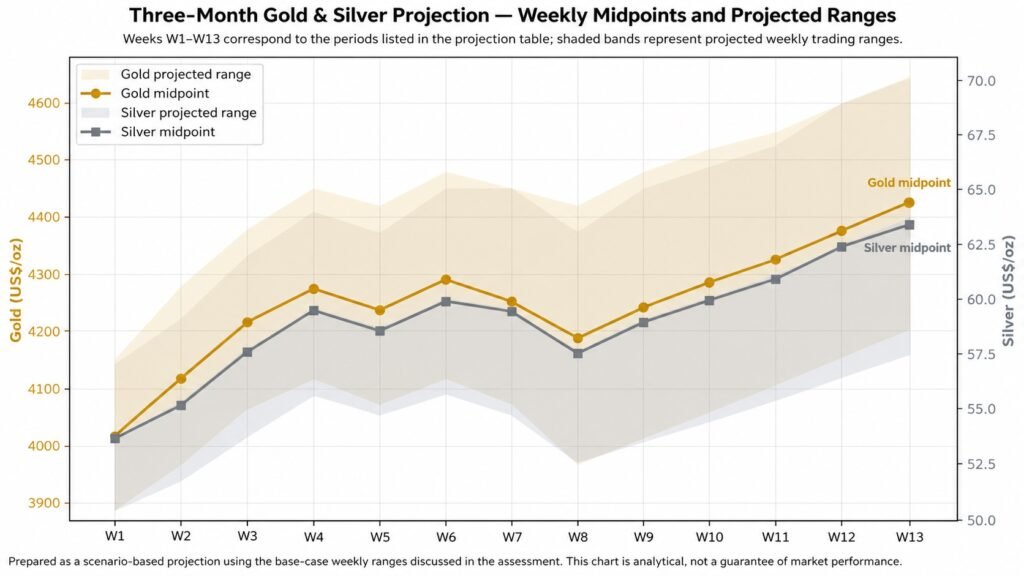
Figure 1. Base-case weekly midpoint trajectory. Shaded areas indicate the projected trading ranges.
9. Scenario Assessment

10. Conclusions
- The three-month outlook remains constructive for both metals, but substantial volatility should be expected.
- Gold remains supported by geopolitical uncertainty, fiscal concerns and political instability; its main near-term obstacle is restrictive U.S. monetary policy and the possibility of higher real yields.
- Silver appears capable of outperforming gold in percentage terms if the gold-to-silver ratio compresses, but the same market structure means that silver is likely to fall more sharply during corrections.
- The central late-January expectation is approximately US$4,400-4,550 for gold and US$62-68 for silver.
- A temporary pullback toward US$3,850-3,900 in gold and US$49-51 in silver would remain compatible with the broader bullish assessment.
- The most important upside risk is a material escalation involving Iran or Gulf energy routes. The most important downside combination would be geopolitical de-escalation, falling energy prices, a stronger dollar and persistently high U.S. interest rates.
- The next three months should therefore be treated as a period of repeated market tests rather than a straight-line continuation of the rally. The underlying environment remains supportive, but corrections and sharp reversals are likely to bepart of the process.
Assessment note: The price projections are scenario-based estimates for analytical purposes and should not be treated as guaranteed market